Some Reflections on Not Being Able to Attend #TGCW12
Guest Post: by Carissa Levering
 A little over a year ago, the Lord called our family to minister the gospel in New England. This was my husband’s first lead pastor role and we were excited, yet anxious and sad as we processed all of the changes that were about to take place in our lives. We were moving much further from family to a place we knew very little about. Yet we knew the gospel was desperately needed there and God clearly confirmed his calling, so we packed up our stuff and our family of almost five and headed for Massachusetts.
This season of our life can really be summed up in one word: transition. We transitioned to a new job, a new community, and a new culture. We came to a place with an extremely kind and generous congregation, yet a place where we really knew no one, while adding our daughter, Eva, two-months after arriving. Life felt like a blur and I felt the frantic pace of it all. Soon after we moved here I made a list of why I am not qualified for ministry in New England and it was a long list! On top of this, I didn’t know how to get anywhere (there is not a straight road in the state and I cried more than once after getting lost!). I wasn’t always sure whom to ask for help (though much was offered). I desperately missed the nearness of my longtime, close, personal friends, and I longed for the ability to call my mom and have her over at my house in five minutes to help me. Amid my own confusion and homesickness for what I knew, I didn’t have any idea how to help my children feel secure here and to help them find a new normal. However I felt the Lord whisper in the quietness that the very reason I am here is because I am not qualified or able, but he is and in my weaknesses he will more clearly be seen.
I wanted to believe this, but I trusted more in the fact that soon the transition phase would come to an end and I would be able to settle in with our family of five, begin ministering more in our church, and finally feel like this was home. Instead of trusting Jesus, I was trusting the changing of my circumstances.
Things began to settle down. Eva was an easy baby, and as she was getting older I was feeling a bit more space and energy to be there for my other kids in the daily activities of life, or to be able to do more with new friendships here. I was feeling encouraged and knew that the Lord was going to slow things down and soon I would be in a place where I could balance family and ministry well. I could be more useful for the Kingdom this way, right?
During this season I signed up for The Gospel Coalition Women’s Conference and found out that I was going to be able to go with two of my best friends. What an amazing God! I was so excited for this weekend, as I knew I would be refreshed and challenged in my faith and I would come home excited, encouraged, and more equipped for ministry both in my home and outside of it.
A few months later I planned to begin a fairly intense exercise routine in order to have even more energy. Now that life was getting easier, I was excited about all of the possibilities we had to explore this beautiful part of the country (with a new baby the summer before, we hadn’t really been able to do that). I decided to take a pregnancy test, knowing I wouldn’t be pregnant, but “just to be safe” since the exercising would be pretty involved. I bought a cheap test, took it in the evening while the family was in the typical before-dinner chaos, and much to my shock found out that we were expecting our fourth baby. No words can describe the shock and emotion that flooded me. But I have a baby…she just learned to crawl yesterday! But I had plans for this summer with my kids. But I want to have energy for the task of raising my small children in a place where I have no family and am a pastor’s wife. But I’m not ready to be pregnant again…I just got out of my maternity clothes! But we don’t have money to have another baby right now! But, but, but, and they just kept coming.
During the first few months I cried about it—not the baby, but being pregnant again and feeling completely incapable of adding to the chaos of an already full life. What was the Lord doing? I felt like the rug of stability was pulled out from under me and I was once again floundering in the sea of uncertainty and transition.
Not long after this our van went out on us and we had to purchase a new one. Amid all this the price of plane tickets to Orlando for the Women’s Conference kept climbing. What was the Lord doing? I prayed for a miracle, but the Lord saw fit for me to be home this weekend.
During this weekend, a weekend in which I was planning on receiving encouragement and refreshment in the Word with close friends, I have been the comfort for a sick and feverish baby, and I have been the comfort for a three-year-old whom I had to take to the ER to have her arm evaluated after it came out of joint. Sleep has been little and I’ve asked many times why the Lord didn’t allow me this time of refreshment. I feel so discouraged, beaten down, tired and I’ve lost perspective on my calling in this world…in New England…in Massachusetts…in my home.
Tonight as I looked at the sweet face of my sick baby and her chubby hand clinging to me in hope that I can somehow make her feel better, and in complete trust that she’ll be okay, I think I see myself. This is where I need to be. Just like my sweet girl I feel yucky…I feel the effects of the instability and of the mundane things of this life. I feel the discouragement of being disappointed when my circumstances are out of my control and so I grasp for control of what I can. In this striving I’m only losing—I’m losing perspective, I’m losing faith, and I’m losing sight of Jesus. As Eva clung to me, I saw that’s where I need to be—clinging to Jesus, just Jesus. Not me, my husband, my family, friendships, my achievements, my opportunities for refreshment, just Jesus.
So in this season of discouragement and lack of perspective may I go back to the quiet voice of Jesus that I heard when we first came. It’s not about you, it’s about Me. Cling to me and I’ll carry you through it all, all your weaknesses, all your failures, all your fears, to a place where you will be able to see me more clearly and where my glory will be more fully known.
“Come to me, all who labor and are heavy laden, and I will give you rest. Take my yoke upon you, and learn from me, for I am gentle and lowly in heart, and you will find rest for your souls. For my yoke is easy, and my burden is light.” (Matt. 11:28-30)
Don’t Be a Lazy Listener
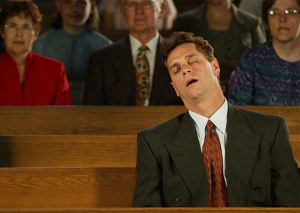 It’s easy to treat a sermon like a spectator sport. We actively participate in the singing or the Lord’s Table, maybe less so in the prayers as our minds tend to wander, and then kick into cruise control when the preacher steps into the pulpit. But if we’re gathered to hear God’s Word, not just the preacher’s words, then shouldn’t listening to a sermon ask something of the listener as well?
Consider Richard Baxter’s comments on “Directions for Profitably Hearing the Word Preached”:
Come not to hear with a careless heart, as if you were to hear a matter that little concerned you, but come with a sense of the unspeakable weight, necessity, and consequence of the holy word which you are to hear; . . .
Make it your work with diligence to apply the word as you are hearing it. . . . You have work to do as well as the preacher, and should all the time be as busy as he . . . you must open your mouths, and digest it, for another cannot digest it for you . . . therefore be all the while at work, and abhor an idle heart in hearing, as well as an idle minister.
Chew the cud, and call up all when you come home in secret, and by meditation preach it over to yourselves. If it were coldly delivered by the preacher, do you . . . preach it more earnestly over to your own hearts. . . .
–Cited in J.I. Packer, A Quest for Godliness: The Puritan Vision of the Christian Life (Wheaton: Crossway, 1990), 254.
In that spirit, here are six practical tips for listening profitably to a sermon: Read more…
A Mosaic of Relational Dysfunction
 What do you do when someone takes advantage of you and no one else seems to care? How do you respond when the time you spend with a friend secretly reinforces your jealousy of their situation—their clothes, their kids, their spouse, their home? How do you handle it when someone prioritizes their career over the commitment they made to you, or when you realize that’s precisely what you’ve been doing but it’s too late to fix it? What happens when the praise you received as you began your new leadership role quickly devolves into bitter criticism and spite? With such fragile relationships in this world, who can you trust?
Ecclesiastes 4 presents us with a mosaic of relational dysfunction. Read more…
The Fog of Life and the Plan of God
 If you’ve ever driven in Nebraska during the winter, you probably know what it’s like to all of sudden lose control of your car (the same may be true of New England, but since my first and only winter here was a yawn, I can’t speak from experience). You turn the wheel, you hit the breaks—no response, no control. It’s frightening. But perhaps even scarier than losing control, is finding out that you never had it to begin with. That’s what Solomon copes with in Ecclesiastes 3 as he explores the effect that time, eternity, and the hidden plan of God have on life under the sun.
I usually post a summary of my sermons in advance of preaching, in order to help people prepare (and hopefully think about whom they might want to bring with them to hear it). Life’s busyness didn’t afford me the opportunity this time around. But you can listen to and download the notes from two sermons on this text. The first one (Eccl. 3:1-15) talks about the beautiful mystery of God’s sovereignty, and how to respond when we realize there’s a pattern at play in this world, but that we’re not the ones crafting it or calling the shots. The second one (Eccl. 3:16-22) takes an honest look at injustice in the world and why all human effort toward social justice will ultimately disappoint, and shares some reflections on what to do with that reality.
Enjoy.
We recently began a new sermon series at Westgate Church through the book of Ecclesiastes. Believe it or not, one of the reasons I selected this relatively obscure and rarely preached book was in hopes that our congregation would be motivated to bring their non-believing friends and family to church to hear its life-changing message. That’s not to say that this is a specifically evangelistic series, as though the only reason for Christians to come is to bring non-Christians. We all need to hear and take to heart the message of this book. But Ecclesiastes does lend itself particularly well to engaging those interested in exploring the faith, and here are four reasons why.
- Ecclesiastes validates their doubts and questions. One of the pervasive (mis)conceptions about Christianity is that there’s no room for honesty about questions, doubts, criticisms, or even skepticism regarding life or the teachings of the Bible. Christians come off as ignorant and naive, making Christ and Christianity look unbelievable and irrelevant. But the book of Ecclesiastes is painfully honest about how messed up this world is. It gives voice to our doubts and suspicions about life, faith, and God, and invites us to wrestle honestly with them.
- Ecclesiastes levels the playing field. Another impression Christians often give is that we have it all together. We come off as judgmental, self-righteous, and unsympathetic (sadly, because we sometimes are). But no one can escape the criticism of Ecclesiastes. Christians seem remarkably human under the penetrating examination of this book—prone to the same trials, frustrations, misgivings, and misplaced hope as the rest of the world. All who sit under this book will find themselves sitting in the same seat—in need of a help outside themselves.
- Ecclesiastes exposes the emptiness of what the world offers. The same critique that knocks Christians down to size also exposes the vanity of all that our unbelieving friends and family look to for lasting gain and significance. One by one, this book dispels the false hope we put in work, wealth, pleasure, knowledge, relationships, religion, power, politics, and everything else under the sun—the kinds of things it’s particularly easy to trust in among the wealthy and well-educated suburbs of Boston. But like a puff of breath on a frosty morning, so Ecclesiastes shows us how everything in this world that we hope in is ultimately fleeting and fruitless—it doesn’t last, and it doesn’t accomplish anything in the end. We need a better hope.
- Ecclesiastes points us to a greater and eternal hope in Jesus Christ. While its critique of life is sharp and startling, the book doesn’t leave us hopeless and depressed, resigned to put up with the vanity of life under the sun. Instead it lifts our eyes above the sun, and points them to Jesus, who took the vanity, sin, and decay of this life upon himself on the cross, and rose again on the third day to bring new life and a new creation. Against the dreary backdrop of life’s empty promises, the hope and joy found only in Jesus shines all the brighter—a hope that changes everything.
So take courage this season. As you wrestle with how this book challenges your own life and faith, pray for your unbelieving friends and neighbors who live daily under the cloud of life’s vanity. Invite them to come with you and take a fresh look at life through the lens of Ecclesiastes.
*For readers who attend Westgate, be sure to pick up a few series postcards this Sunday that you can use as invitations for friends.
 In 2007, New York-based designers teamed up with Florida-based high-rise builders, Las Vegas architects, and a team of investors to create what would have been one of Las Vegas’s “largest, most unapologetically glamorous hotels”—the $2.9 Billion Fountainebleau. But just two years into the construction the economic recession brought everything to a grinding halt. To this day the project sits 70% complete, beams exposed, with no sign of completion in sight. All the wisdom that went into designing and planning this magnificent creation, all the hard work that went into constructing it . . . and nothing to show for it.
There’s an uncomfortable parallel between this building and our lives in a fallen world. Read more…
Mother’s Day and Romans 12:15
 This Sunday is a special day for so many people. I can’t express how thankful I am for my own mother and the countless (and I mean countless) ways that she has loved and served me, not only growing up, but even with my whole family now. And of course I am equally without words in gratitude for my wife, Carissa, and the kindness, wisdom, and affection she lavishes on our children. She is simply incredible, and you all should be jealous of me. Add to it my loving grandmothers, mother-in-law, and grandmother-in-law, and I am a very blessed man indeed.
But for many this day is rather painful. The sorrow of miscarriage, the stinging grief of having lost a child, the loneliness and sadness of having lost a mother or grandmother–all of these make an otherwise happy celebration overwhelmingly bitter.
So in our interactions with others, how do we navigate the conflicting emotions of the day? Read more…
My good friend James Sharp offers some thoughtful comments on the purpose of marriage. Be sure to watch the video at the end.

My wife and I recently began premarital counseling with a young couple from our church. We’re excited for the opportunity to invest in them and build a friendship with them that, Lord willing, God will use as they begin their marriage and family for the glory of Christ. As I was preparing for our time with them, I plowed through a handful of the best gospel-centered marriage books out there. Married and unmarried Christians alike have much to be thankful for these days, as there are tons of great resources available to help us understand what the apostle Paul himself calls a “profound mystery” (Eph 5:32) – the physical/spiritual union between husband and wife that displays for the world the glory of Christ by revealing the nature of the gospel.
The world assumes that marriage is for the benefit of the married. When successful, it helps establish economic…
View original post 229 more words
Invitation to Ecclesiastes

This week we began a new series at Westgate Church: Work, Wealth, Pleasure, Knowledge, and Other Dreams that Disappoint: The Surprising Hope of Ecclesiastes. This is a long title, but it’s designed to capture the tension that we find in this book—a tension that makes Ecclesiastes so obviously relevant for those who live in New England today, and more specifically in Greater Boston. In fact part of our desire for this series is that people would step out to invite friends and neighbors to come and wrestle with life through the honest yet hopeful lens of Ecclesiastes.
Do a random survey on your street, in your school, at your office, in your child’s play group, and ask a simple question: What do you live for? What do you look to for lasting significance and gain? Among others, you’re going to hear these answers: Read more…
The Mess and Order of a Gospel-Centered Church
Thoughtful, exciting, and freeing reflections for a congregation seeking to be a gospel-centered community living each day on mission for Christ. Jared Wilson writes:
When a church is faithful to preach the gospel and demonstrate the gospel’s implications, it will usually find that it attracts and is attracted to the kind of people Jesus attracted and was attracted to. People who are, shall we say, rough around the edges.
The gospel well preached and applied will make ministry messy. Things will change. I often think of it like the beating of a rug — you’re gonna get a lot of dust in the air. There will be a thick cloud. The gospel stirs stuff up.
But our God is not an author of confusion. So as things get messy, while the gospel is creating a safe space for sins, hurts, and struggles to rise to the surface, it is outlining that space really well. The same gospel that exposes mess creates order.
How? In a gospel-centered church, one will find that:
There are leaders who are humble and confident and grace-ready.
There are church members grace-ready.
There are opportunities for counsel
There are opportunities for discipleship.
There is biblical church governance, church membership, and church discipline.A safe space is not an amorphous, undefined space. The gospel brings junk up and then sorts junk out.

 in the meantime