Why I’m Preaching Ecclesiastes from the ESV
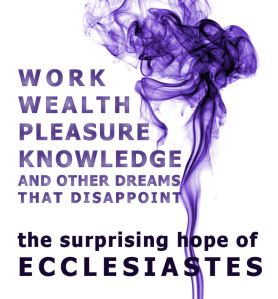 In just over a week I’ll begin a new preaching series at Westgate Church: Work, Wealth, Pleasure, Knowledge, and Other Dreams that Disappoint—The Surprising Hope of Ecclesiastes. And though the Bible version in our church pews and usually up on the screen is the New International Version (NIV), I’ll be preaching this series from the English Standard Version (ESV). I thought it would be good to explain why. Read more…
Last week marked one year since I preached my candidation sermon at Westgate Church in Weston, MA. My friend and former colleague, Eric McKiddie, asked me to reflect on some lessons learned during my first year as a lead pastor. You can read them at his blog, Pastorlized (where you can find a ton of helpful reflections and essays on pastoral ministry).
Christianity in Crisis? A Good Response by Trevin Wax
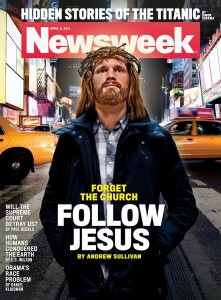 Trevin Wax writes:
Newsweek’s cover story, written by popular author Andrew Sullivan, encourages Americans to “forget the church” and just “follow Jesus.” . . .
Sullivan sees the problem of a politicized faith, one that focuses relentlessly on gaining power, changing laws, and regulating the morality of others. He sees contemporary Christianity as a faith obsessed with getting doctrines about Jesus right to the exclusion of what He actually taught us to do and be. . . .
From the Catholic Church’s teachings on sexuality to evangelical Christian support of torture, Sullivan makes his way through a long list of perceived threats to the centrality of Christ among believing people.
So what’s the solution? Sullivan points us toward Francis of Assisi and Thomas Jefferson. Francis – for the simplicity of his vision for following Jesus. Jefferson – for the way he stripped away all the miracles of incarnation and resurrection and got to the greatest miracle of all: Jesus’ message of love.
Wax sympathizes with the questions and critiques that Sullivan raises (being more charitable than I; Sullivan’s historical inaccuracies and theological caricatures would hardly be permissable in a freshman religion class), but puts his finger on several critical flaws. His full response is well worth the read.
Wax concludes:
Sullivan wants to take Christ’s teaching without Christ Himself. His vision tries to deliver Christ’s message of love without the atoning cross that gives love its meaning. It wants Christ’s justice without the victorious resurrection that launches the new world God has promised , the new world that totally changes the landscape for how we view everything: ethics, morals, politics, art, law. . . .
The answer to Andrew Sullivan is to point back to everything the Gospels tell us. Let’s not isolate the sayings of Jesus we like and fit Him into our vision for how the world should work. Instead, let’s fall at the feet of King Jesus, ready and willing to do whatever it takes to fit our lives into His vision, a vision of the world to come that has crashed into the world that is.
Isaiah 52:1-12: Behold your King!
 It’s hard to make sense of the excitement and fervor of Palm Sunday unless we realize that Jerusalem remained in many ways a city under siege. Though the exile to Babylon had technically ended centuries before, much of what God promised his people remained a distant dream. There was no king on the throne; they remained under foreign oppression. Jerusalem was a shell of her former glory. The great city of God was occupied territory, living out her days in sorrow and slavery.
This is the portrait of Jerusalem we see in Isaiah 52: a rebellious wife, divorced by God because of her adultery with the idols of the surrounding nations, grieving in dust and ashes, defiled by her foreign lovers, captive because of her sin (vv. 1-2). And this is true of all humanity, not just ancient Israel. All are rebels against God’s throne, rejecting him as king, guilty of high treason.
And yet the message of Isaiah 52, and of Palm Sunday, is that God our king has not left us in our slavery or our sin, but sent his Son to buy us back for himself, and to bless us with every good promise of life with him. Read more…
Westgate’s new website is live!
Our web presence at Westgate just got a new look.
We’re thankful for the good people at Church Plant Media who designed and are hosting our new site, and for Nate Friedrichsen, our tireless graphic designer. And many thanks to Nancy Brown, Becky Borland, CJ Godfrey, and Bruce Daggett for the many hours they’ve put in to getting it ready for launch, and to Dave Kwak and Ippei Takahashi for several of the photos.
It’s still a work in progress, and we’ll continue updating and adjusting things here and there. But we hope you enjoy clicking around and that the information you find is helpful.
Stop by and see the new digs when you get a chance…
Philippians 4:14-23: The Sweet Aroma of Gospel Partnership
 The aroma of spring is in the air (and the allergy attacks that come with it). There’s something about smelling the clean air and fresh flowers that warms the heart. Just as there’s something about smelling the dirty diapers in the trash that turns the stomach.
Smells affect us—for better and for worse. From the heavenly aroma of meat on the barbeque to the choking odor of a crowd of teenage boys bathed in Axe Body Spray, smell is a powerful thing.
In Philippians 4:14-23, Paul describes the way we live our lives before God as giving off a particular smell—the sweet aroma of an acceptable sacrifice. Read more…
Jeremiah Burroughs: The Rare Jewel of Christian Contentment
 “Not that I am speaking of being in need, for I have learned in whatever situation I am to be content. I know how to be brought low, and I know how to abound. In any and every circumstance, I have learned the secret of facing plenty and hunger, abundance and need. I can do all things through him who strengthens me.” Philippians 4:11-13
Jeremiah Burroughs was a Puritan pastor in the Church of England during the seventeenth century, who learned firsthand the lesson Paul spoke of—being content in either plenty or want. He entered his first pastorate at the age of 26, and it ended in failure three and a half years later. Five years into his second pastorate he was suspended from the ministry by the Church of England for his refusal to participate in what he considered “the superstitions” of the Anglican church—a long list of rituals and requirements that had no biblical foundation. A year after his suspension he was formally deprived of his living, and had to be taken in by a family. He left England a year later for Holland, presuming that he’d never see his country again. Burroughs tasted trial, humiliation, and want.
But then in 1641, the new Parliament allowed all ejected ministers to return to England, and Burroughs was appointed to lectureships including two of England’s largest, wealthiest congregations. He was consequently very well paid.1
But he found his contentment neither in his neediness nor his prosperity. Read more…
Philippians 4:10-13: Satisfied in Jesus
 There’s a reason that the rollercoaster has become a cliché for life: circumstances fluctuate in this fallen world. And with them, so often does our joy. On a good day, when life goes as planned, we feel good, stable, secure. But when life crests and we feel like we’re starting to plummet, we’re filled with anxiety and fear. We get edgy and sharp with those close to us, we grasp for control or look for the nearest escape. Then things turn, and we’re happy again. At least for a little while, until the cycle starts all over. Lather, rinse, repeat.
But what could life look like if our joy was able to travel above our circumstances? What if delight was consistent, even when the world was not? Is such a thing possible? Or is the very thought a mere sandcastle of “positive thinking,” ready to collapse with life’s next crushing wave?
According to the apostle Paul, consistent joy is not only possible, it’s commanded. It’s a command he’s issued multiple times throughout the book of Philippians, the secret of which he reveals in 4:10-13. Read more…
8 Non-Negoitables for Mobilizing the Local Church for Accomplishing the Great Commission
 Justin Taylor shares this summary of David Platt’s talk last night at the Verge12 Conference. May God grant local churches the grace to be faithful to the cause of the gospel.
David Platt, speaking at Verge12.
Two assumptions:
1. The Great Commission can be accomplished and will be completed.
2. Pastors and church leaders are moblizers and equippers for people in the local church.
Eight non-negotiables:
1. A God-centered God. We must give the people we lead a glimpse of the God-centered God who exalts himself.
2. A word-saturated ministry. We give them a glimpse of the glory of God by giving them the Word of God. It’s the only thing that will drive them into mission and then sustain them. Biblical theology drives urgent missiology.
3. A life-changing gospel. Maybe one of the reasons so many in the church aren’t making disciples of all the nations is that they aren’t really disciples in the first place. Should it not concern us that the Bible never offers a “sinner’s prayer” and never talks about “accepting Jesus into our heart.” We have modern evangelism built on sinking sand that runs the risk of ruining souls. We must be very careful about assuring people they are Christians when they have not responded to the gospel. It’s damning to drain the lifeblood of Christianity and replace it with Kool-Aid. They need to see the greatness of God—he is a loving father who may save us, but he is also a wrathful God who may damn us. In the original Greek, “dead in your trespasses and sins” means “dead.” We have developed many methods of ministry that require little or no help from the Spirit of God. One of the greatest hindrances to the advancement of the gospel is the attempt of the church of God to do the work of God apart from the power of the Spirit of God.
4. A Spirit-empowered church. We have created a church culture that does not depend on the Spirit. We need to be desperate for the Spirit of God.
5. A Christ-driven strategy. Go and make disciples of all the nations.
6. A peoples-focused goal. Panta ta ethne (ethno-linguistic people groups, not socio-political nation-states). The Great Commission is not a general command to make disciples among as many people as possible, but to make disciples among all the people groups. “Unreached” people is not the same as “lost” people. The difference is access. If we are not mobilizing our people to go to unreached peoples, we are not being obedient to the Great Commission. Our obedience is incomplete. Ladd: Christ has not yet returned, therefore the task is not yet done. We are not completely missional if we are not engaged in reaching unreached peoples.
7. A multifaceted approach. Let’s not take both-and’s and turn them into either-or’s. Local and global. Spiritual and physical. Pray and go. Short-term and long-term.
Why don’t we just let the locals do it? That’s the point! With the unreached there are no locals!
8. A death-defying commitment. “Then they will deliver you up to tribulation and put you to death, and you will be hated by all nations for my name’s sake” (Matt. 24:9). It will be costly. Satan is—in a sense—fine with us spending all our time with people around us while ignoring the unreached. When we engage the unreached, we will be met with the full force of hell. Are we willing to pay the price? Are we willing to redesign church budget and family budgets? Are we willing to let go of programs and preferences? Are we willing to lead and shepherd people, telling them, “This may cost you everything.” At the same time, we must not forget the reward. There is coming a day when the trumpet will sound, Christ will return to receive the reward he is due. And all the peoples of the earth will be represented around the throne, crying out, “Salvation belongs to our God!” Those people will not seeing letting go of the things of this world as “sacrifice.” He is worth it.
Philippians 4:8-9: A Gospel-Shaped Perspective
 During World Wars I and II, citizens on the Allied home front were asked to make major sacrifices. In the U.S., basic goods like coffee, sugar, gasoline, clothing, shoes, meat, cheese, canned foods, and all sorts of other things were rationed since resources and funds were being directed to the war front. People were encouraged to plant victory gardens to offset the war’s impact on the food supply and to invest in war bonds to support the effort. Every day was lived with an awareness that the country was at war, and that everyone had a role to play.
As the people of God living on mission for Christ amid a fallen world, we too live in wartime (cf. Phil. 1:27-28; Eph. 6:12). And so we need a wartime mentality. To put it another way, we need a gospel-shaped perspective—a way of thinking that focuses our minds and hearts to live faithfully as God’s people on mission for Jesus. We need to know how to think and what to do. And that is what Paul lays out for us in Philippians 4:8-9. Read more…

 in the meantime