 At Westgate Church, we are committed to what is often called biblical exposition. It’s the kind of preaching where the message and aim of the sermon are controlled by the message and aim of the biblical passage being preached.
In our first post in this series, we talked about what biblical exposition is. Now our question is why biblical exposition is necessary for the life and health of our church. In the last post we suggested that exposition is necessary because it reflects a healthy doctrine of Scripture. Here we consider a second reason: biblical exposition respects the God-given shape of Scripture. Read more…
Why Biblical Exposition? It reflects a healthy doctrine of Scripture
It’s not an exaggeration to say the preaching of God’s Word is the center of our gathered worship at Westgate Church. This is intentional, and reflects our commitment to what is often called biblical exposition.
In the last post, we talked about what biblical exposition is: the kind of sermon where the message and aim of the sermon are controlled by the message and aim of the biblical passage being preached.
In the next three posts, we’ll talk about why biblical exposition is necessary for the life and health of our congregation. The first reason: it reflects a healthy doctrine of Scripture. Read more…
What is Biblical Exposition?
If you’re part of Westgate Church, or have visited us on a Sunday morning, it’s probably pretty obvious that the preaching of God’s Word is an important part of our gathered worship. The sermon receives the most time during our service. The songs we sing and prayers we pray emphasize the same message as the sermon. It occupies the central location in our order of service. Even the pulpit sits in the center of the platform up front. And each sermon reflects somewhere between 15 and 20 hours of the pastor’s study during the week. It’s not an exaggeration to say the preaching of God’s Word is the center of our gathered worship.
All of this is not without reason. In fact, it’s very intentional, and it reflects our commitment to what is often called biblical exposition.
So what is biblical exposition? And why is it so central to our gathered worship? These are the questions we’ll explore in this series of posts. We’ll start here with the first one: what is biblical exposition? Read more…
Does Sin Deserve to Be Punished?
 Christopher Wright addresses a critical question in our understanding of what Jesus accomplished on the cross:
*****
As I ponder all aspects of the cross and try to assess what it means to include the word ‘penal’ in our understanding of Christ’s substitutionary death, I cannot escape asking the question again, Does sin deserve to be punished? And is such proper retribution part of God’s sovereign, holy, loving justice in ruling the universe he created?
If not: then great swathes of the Bible make no sense or are clearly in error. For the Bible affirms from cover to cover that there is a dimension of just and proper punishment with which God in holy, loving justice responds to human wrongdoing.
If not: then we would seem to be adrift in a universe of ultimate moral indeterminancy. We can have no confidence that justice will finally be done, that God himself will be vindicated, or that all the evil in the history of the world will ever be fully dealt with.
If not: then the very concepts of grace and mercy seem to be emptied of meaning. It has been said that grace is God giving us what we don’t deserve, while mercy is God not giving us what we do deserve. Certainly, in the Bible grace and mercy override all that we could ever, or actually do, deserve. But if there is no such thing as ‘what we deserve’ at all, no moral relationship between our behaviour and its consequences, then it seems vacuous to speak of grace or mercy.
But if so: then it seems inescapable that we should include this dimension in the great cosmic achievement of the cross of Christ. To say that ‘Jesus bore my sin on the cross’ must mean not only that he bore the worst that my sin could inflict on him (though it truly does mean that), but also that he bore the consequences of what my sin would otherwise incur for me. It means not just that Christ bore my unjust deeds, but also that he bore my just deserts. He not only took what I did to him; he took what I deserve from God.
*****
– Christopher J.H. Wright, The God I Don’t Understand (Grand Rapids: Zondervan, 2008), 152-153.
Failing to Recognize the Holiness of God
 Jerry Bridges has stated (quite accurately, in my estimation), that the most fundamental need for the church today is an ever-growing awareness of the holiness of God.1 In our previous post we talked about what we mean by God’s holiness: his unique transcendence, his supreme majesty, his moral perfection, the perfection of all his other attributes.
But what happens to God’s people when we lose sight of God’s holiness? When instead of seeing God as above us, unlike us, over us, bigger than us, and the source and standard of all that is good, just, and loving—we see him as altogether like us?
This was the problem that ancient Israel faced in Psalm 50. They had been carrying on in sin, assuming they had evaded God’s notice since he had so far said nothing in response. But in Psalm 50, God breaks the silence and calls them to account. Read more…
Recognizing the Holiness of God
 Jerry Bridges, an author and longtime staff with the Navigators, whose books have been particularly formative for my life and ministry, was asked not long ago in an interview what he thought the greatest need was in the church today. His answer: “There are so many needs in the church today that it is difficult to single out one as the greatest. However, if I had to pick one, I would say the most fundamental need is an ever-growing awareness of the holiness of God.”1
When I read his answer, it immediately resonated with some of what I was observing, not just in the spiritual climate of New England and the small view of God that so many have in these parts. It resonated with what I saw in my own heart. The way I find myself tolerating sin, or getting caught up in what others think of me. How I find myself at times unmotivated to follow God, or to spend time with him. How I can at times treat other things as more valuable or satisfying than him. I fail to recognize his holiness. In the language of Psalm 50:21, I begin to think that God is altogether like me. And I therefore find him rather unimpressive. Even offensive at times. How dare he weigh in with judgment on something I find so valuable and meaningful?
The most fundamental need for the church today is an ever-growing awareness of the holiness of God. What do we mean by God’s holiness? Read more…
The Scandalous Satisfaction of Forgiveness
 “And getting into a boat he crossed over and came to his own city. And behold, some people brought to him a paralytic, lying on a bed. And when Jesus saw their faith, he said to the paralytic, ‘Take heart, my son; your sins are forgiven.’” (Matthew 9:1-2)
I can think of few things that would be more debilitating and disheartening than paralysis. So when you consider the gravity of this man’s need, and the goal of his friends in bringing him to Jesus, there’s something shocking, if not downright scandalous, about Jesus’ response. The emphasis on his authority to forgive sins seems a bit callous and ignorant at first. It feels a bit like ordering a steak and being served an empty plate with a little garnish on the side. It’s kind of a nice finishing touch, but I’m not sure how that little twig there is going to fill me up or address my need, my hunger. It’s kind of a nice bonus to be forgiven of sin, but I’m not sure what I’m supposed to do with it laying here on the mat.
This is by no means the first time that the sick have come or been brought to Jesus in Matthew’s Gospel (see Matt. 4:23-24; 8:1-17). So when these men bring their paralyzed friend to Jesus, believing and expecting him to be healed, we can’t fault their aim or request, and we certainly can’t fault their faith.
But that Jesus’ response is such a shock (at least to us as readers), suggests a significant flaw in our general perspective of things. We have a tendency to focus on earthly needs and problems, while overlooking the bigger spiritual picture of God’s kingdom and our deeper spiritual need to be forgiven and reconciled with God. Read more…
Hope in the Face of Disability
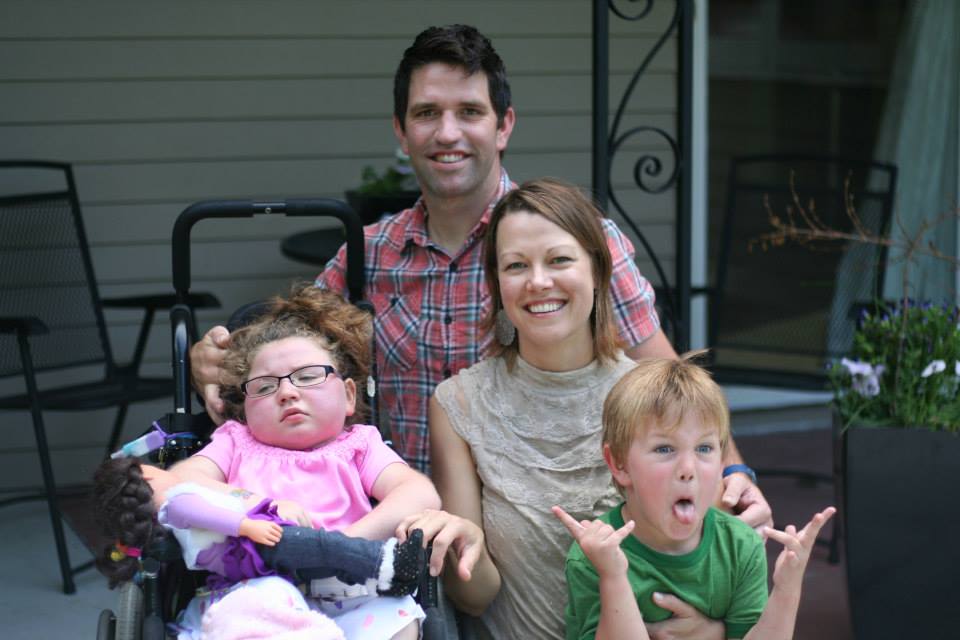 For those who joined us at Westgate Church this morning, I began the sermon on Matthew 8:1-17 by telling a little about my longtime friend, Steve Allen, and his family’s experience with disability.
When their firstborn, Amelia, was about three or four months old, she was diagnosed with Leukemia. Four rounds of chemo killed the cancer; she is still in remission today. But during that fourth round a virus settled in her brain and destroyed Steve and his wife Jen’s dreams of a so-called ‘normal’ life. Amelia’s brain damage was severe. She is a beautiful six-year-old today, but her life is not like most children. She’s confined to a wheel chair. She can communicate, but not with her mouth or her hands, but with her eyes—the direction she looks.
I’ve shared before about the encouragement Steve, Jen, Amelia, and Miles have been to my life. To learn more about their story of trusting God in the face of disability, I encourage you to watch this video about their story.
SCOTUS and Gay Marriage: A few helpful resources
 Two days ago the Supreme Court issued two historic and rather controversial rulings on the definition of marriage in the United States. Here are a few responses and reflections that I have found helpful for understanding and processing this event.
For a succinct breakdown of what these rulings do and do not mean, see Joe Carter’s “9 Things You Should Know about the Supreme Court’s Same-Sex Marriage Cases.”
Trevin Wax reminds us that in the big picture of God’s sovereignty and our call to gospel witness, gay marriage is both good and bad for the church. He writes, “If we truly believe Romans 8:28, that somehow, in some way, God is working all things for the good of those who love Him, then even when the culture swerves in an opposing direction, we ought to expect both benefits and challenges.” Wax goes on to describe more specifically how three developments will likely present both trials and opportunities for the Church’s gospel witness in the years ahead: (1) The Loss of a Culture of Marriage; (2) Threats to Religious Liberty; and (3) The Cost of Conviction.
Similarly, Russell Moore reminds us that these decisions and the culture they reflect are an opportunity for gospel witness:
This gives Christian churches the opportunity to do what Jesus called us to do with our marriages in the first place: to serve as a light in a dark place. Permanent, stable marriages with families with both a mother and a father may well make us seem freakish in 21st-century culture. But is there anything more “freakish” than a crucified cosmic ruler? Is there anything more “freakish” than a gospel that can forgive rebels like us and make us sons and daughters? Let’s embrace the freakishness, and crucify our illusions of a moral majority. . . .
The increased attention to the question of marriage also gives us the opportunity to love our gay and lesbian neighbors as Jesus does. Some will capitulate on a Christian sexual ethic. There are always those professional “dissidents” who make a living espousing mainline Protestant shibboleths to an evangelical market. But the church will stand, and that means the gospel Jesus has handed down through the millennia. As we stand with conviction, we don’t look at our gay and lesbian neighbors as our enemies. They are not.
The gay and lesbian people in your community aren’t part of some global “Gay Agenda” conspiracy. They aren’t super-villains in some cartoon. They are, like all of us, seeking a way that seems right to them. If we believe marriage is as resilient as Jesus says it is (Mk. 10:6-9), it cannot be eradicated by a vote of justices or a vote of a state legislature. Some will be disappointed by what they thought would answer their quest for meaning. Will our churches be ready to answer?
Moore’s conclusion is worth careful consideration:
Same-sex marriage is headed for your community. This is no time for fear or outrage or politicizing. It’s a time for forgiven sinners, like us, to do what the people of Christ have always done. It’s time for us to point beyond our family values and our culture wars to the cross of Christ as we say: “Behold, the Lamb of God who takes away the sins of the world.”
Finally, for some of my own reflections on how the gospel of Jesus ought to shape our understanding of the broader issue, as well as our posture toward our gay friends and neighbors, see my earlier post, “The Gay Movement is a Gospel Issue.”
 Friends, read (and pray!) this incredible reminder from Scotty Smith. May we never go a day without realizing our need for the gospel and rejoicing in God’s gracious provision of all we need in Jesus through the Spirit.
*****
I am eager to preach the gospel to you also who are in Rome. For I am not ashamed of the gospel, for it is the power of God for salvation to everyone who believes, to the Jew first and also to the Greek. For in it the righteousness of God is revealed from faith for faith, as it is written, “The righteous shall live by faith.” Rom. 1:15-17
Dear Lord Jesus, even as Paul was eager to preach the gospel to believers in Rome, so I’m eager to preach it to my own heart today. There was a time when I thought the gospel was only for nonbelievers—simply the doorway for beginning a relationship with you. I now realize believers need the gospel just as much as non-believers. From beginning to end, our salvation is entirely dependent upon the grace, truth, and power of the gospel. Indeed, there’s nothing more than the gospel, there’s just more of the gospel.
So I praise you today, Lord Jesus, that you’ve already accomplished everything necessary to completely redeem us, and restore us to your image. You’re not primarily our model to follow; you’re our substitute to embrace—not our second chance, but the “second Adam.” You lived a life of perfect obedience on our behalf, fulfilling all the demands of God’s law for us. And when you died upon the cross, you became sin for us—completely exhausting God’s righteous judgment that stood against us. Hallelujah, many times over!
Through faith in you, I know for certain, that all of my sins have been forgiven—sins in the past, present and future; not just the 4% I’m aware of, but the other 96% as well. And I’ve also been given the gift of your perfect righteousness—as though every good thing you did, I did. Astonishing! God has already declared me to be righteous in his sight; and he cannot love me more than he does today, and he’ll never love me less.
In fact, because of your work for me, Lord Jesus, God now loves me just as much as he loves you, for he’s hidden my life in yours. Amazing! He’s adopted me as his child and placed his Spirit in my heart. The Holy Spirit constantly reminds me I’m God’s beloved child, because I’m so prone to forget. And he’s also present in my life to make me like you, Jesus, for I can no more change myself than I could’ve ever begun a relationship with God on my own.
As our great high priest, you are ever living to pray for us—praying what I would pray if I knew what you knew. As the resurrected and reigning King, you are working in all things for our good and your glory. All of history is bound up with your commitment to redeem your Bride from the nations and make all things new. Nothing is left to chance; all things are left to you!
One Day, (hopefully soon), you will return, Lord Jesus, and usher in the new heaven and new earth—the world of perfect peace, love and joy. My heart leaps and longs for that Day, when your people, every place and all things will exist for the praise of your glorious grace. Keep pressing this gospel into my heart. So very Amen I pray, in your priceless and peerless name.
*****
From Scotty Smith. HT: Collin Hansen
P.S. Scotty’s Everyday Prayers: 365 Days to a Gospel-Centered Faith is available on Kindle right now for $1.99. Get it!

 in the meantime